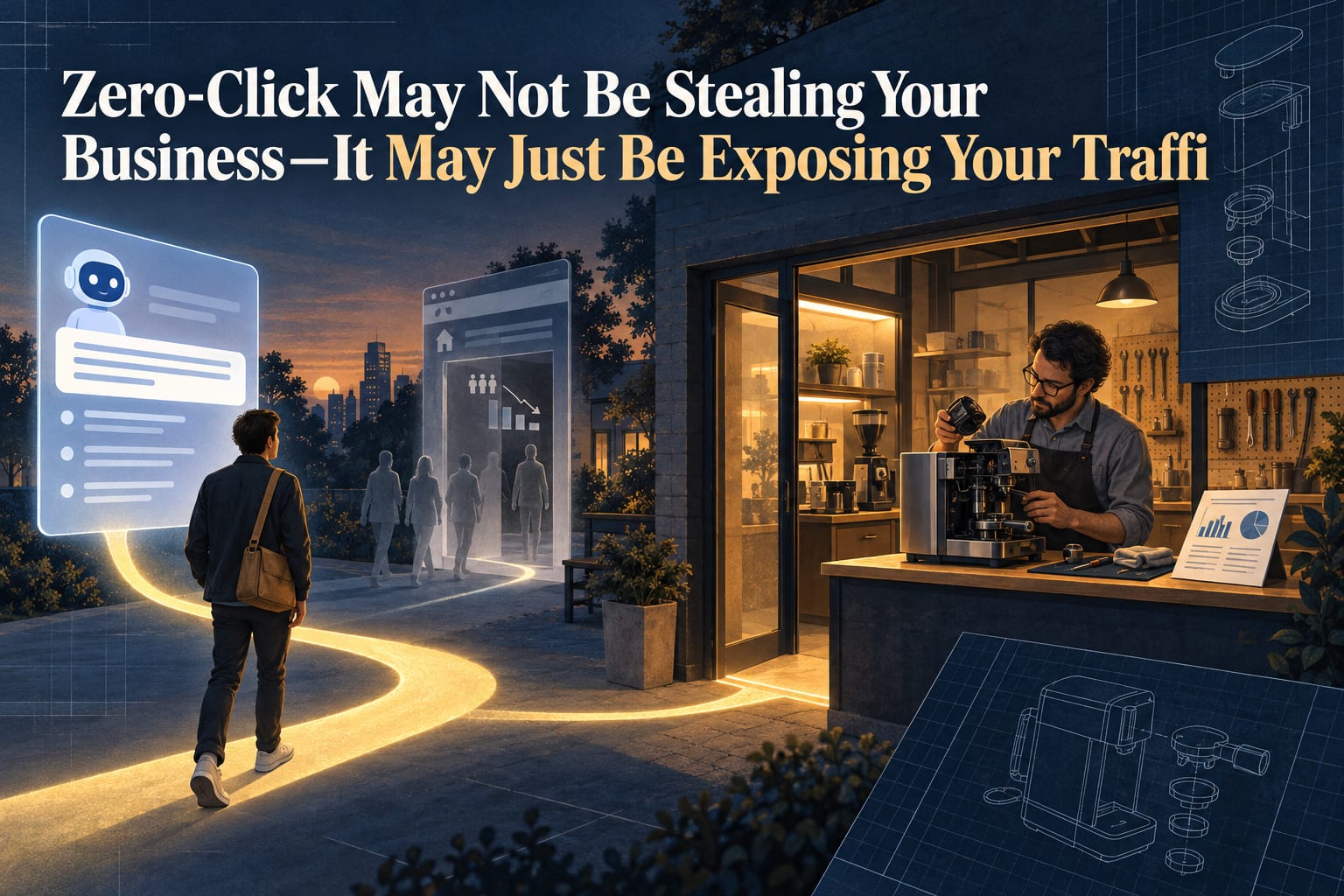
When I see topics like AI tool traffic rankings, my first thought is a question that spoils the fun: everyone is eager to see whose gateway draws the biggest crowd, but what businesses need to know is who actually brings them customers.
We used to lazily treat these two things as one and the same.
When search results provide answers directly, users don't have to click through to a website. That's zero-click. With AI search, even comparisons, filtering, and reasons for recommendations may all be handled at once. Businesses have every reason to worry: I write the content, you serve up the answers, and before my website even opens its doors, customers have already had their fill on the doorstep.
But I lean toward a more uncomfortable view: zero-click may not hurt your business first. It may first expose the traffic that never brought you any business in the first place.
One Fewer Visitor in the Report, One More Work Order in the Shop
Suppose you run an air conditioner repair business. Someone searches for “what to do when an air conditioner drips water,” reads an article, cleans the filter themselves, and leaves. That's a website visitor, but not necessarily a business opportunity.
Another person asks AI directly: “Any recommendations in Banqiao for someone who can come repair my air conditioner tonight and issue an invoice?” If the answer provides your business name and phone number, they may call you directly. The website gets no click, but the order comes in.
These are two completely different kinds of zero-click: one makes the need disappear within the answer; the other lets the need bypass the website and reach the business directly. Counting both as “stolen traffic” is like counting only the people outside a restaurant without checking who sits down and orders. The counter is busy; the ledger is quiet.
Of course, for content websites that sell advertising space, one fewer page view may mean one fewer opportunity to earn revenue; professionals may also lose the chance to help customers understand their services. You can't take one repair shop's work order and declare that no website needs clicks.
What Really Hurts Is That You Can't Even See Why You Were Passed Over
The deeper impact of zero-click is that businesses lose the space to explain themselves.
In the past, customers visiting a photographer's website might see their work, understand the pricing, and then accept that they are “more expensive, but good at photographing people who are camera-shy.” Now, AI may first condense that into a single phrase: “Higher prices.” Before you've even met, your value has been compressed into a drawback.
At that point, writing ten more articles on “recommended photographers in Taipei” may not solve the problem. If your portfolio doesn't explain the shooting situations, scope of services, and deliverables, more words may simply mean more adjectives. AI has no obligation to fill in the blanks about how much “professionalism and care” are actually worth.
What matters more to me is this: Have you left evidence of what sets you apart that can be verified and compared? For example, whether you can travel to customers, whether you accept rush jobs, what your fees include, and whose problems your past projects actually solved. This information makes it easier for people and systems to understand you, but it doesn't guarantee a recommendation; recommendation mechanisms may still be biased. Don't dress up “AI can understand it” as yet another traffic talisman.
Marketers are also stuck with a practical reality: website clicks are easy to report as results, but the words “AI recommended you to me” over the phone are hard to attribute. If teams chase only metrics that are easy to measure, they may keep producing articles that get swallowed by summaries while no one updates business hours that have long been out of date.
On Friday evening, a customer walks into the shop, phone in hand, saying AI told him they could repair a certain coffee machine model. The owner glances at the model: “We stopped servicing this one last year.” This month's website ranking report is still lying beside the counter.