How Should You Respond to Negative Google Reviews? Steps and Adaptable Examples
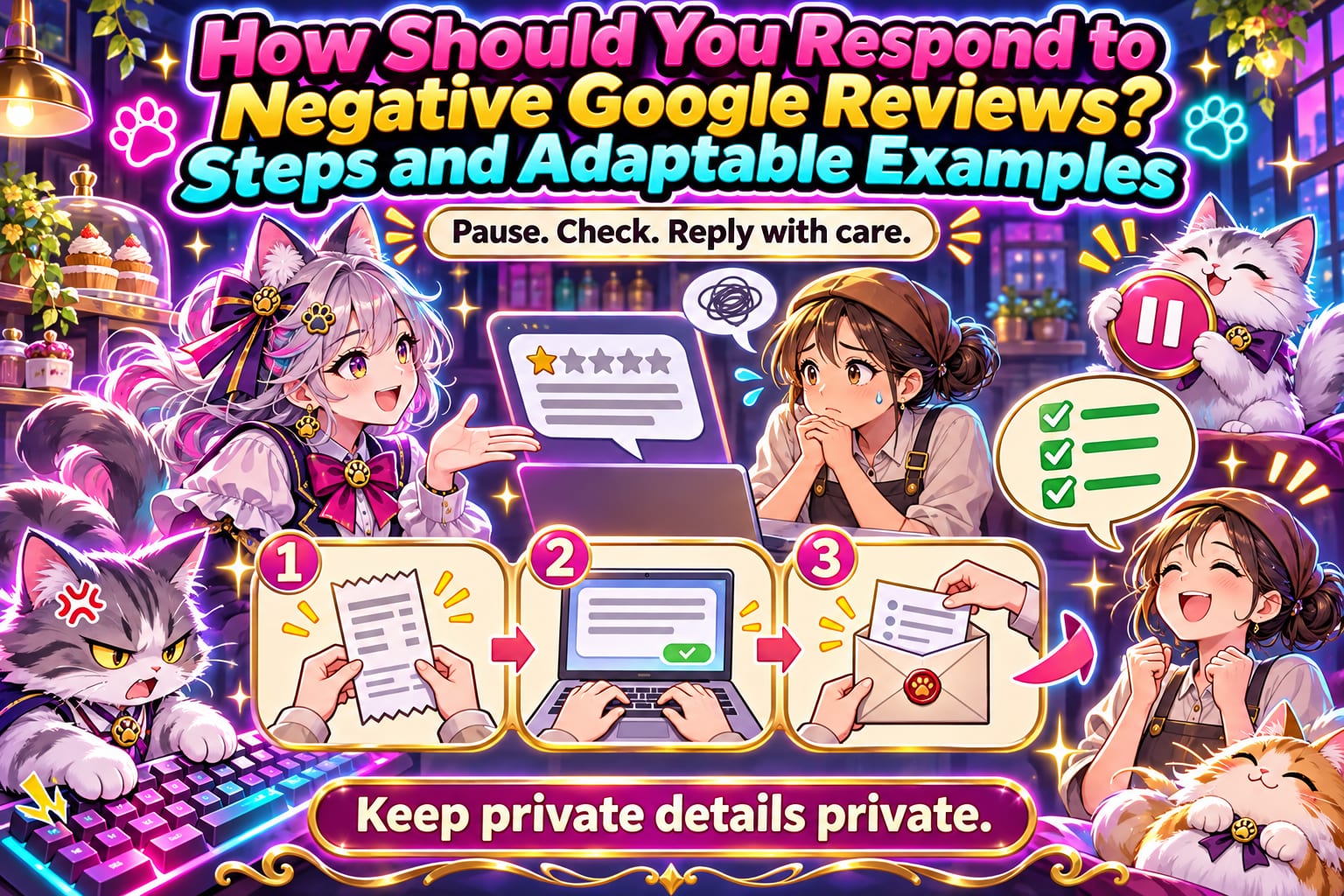
When responding to negative Google reviews, first verify what the reviewer is reporting, then reply publicly in this order: address the issue, explain how you will handle it, and provide a contact channel. Apologize if there was an actual mistake; if the facts are not yet clear, explain that you need to check. Do not rush to argue, and do not disclose customers’ personal information. This article walks you through verification, drafting, posting, and follow-up, and provides examples you can adapt directly.
What Should You Do First When You Receive a Negative Review?
Do not hit publish while you are angry. A public response does more than let the reviewer know you are handling the matter. It also shows other readers how your business takes responsibility when problems arise.
First, determine which category the review falls into:
- A specific customer issue: For example, a long wait, an incorrect product, or poor service. Verify the facts first, then offer a way to resolve it.
- Insufficient information or a possible misunderstanding: For example, a review that only says “terrible.” First express your willingness to understand, then ask the reviewer to provide more information privately.
- A suspected violation of platform policies: For example, harassment or personal information. Keep the necessary records, then report it through the platform’s process; a negative review alone does not constitute a violation.
If there are threats of physical harm, address staff safety first rather than treating it solely as a writing issue.
How Do You Respond to a Negative Google Review Step by Step?
Find the review and record the issue. Using the account that manages your Business Profile, find your business on Google Search or Maps and open the review management section. Note the review date, the issues raised, and anything that needs verification. Once done, confirm that you have selected the correct branch and review. Refer to the latest official instructions for interface names and operating procedures.
Verify the facts internally. Check order, reservation, or customer service records against the time and incident mentioned in the review, and ask the colleagues who were on duty. Once done, divide the information into two categories: “confirmed” and “still unclear.” If you cannot find a record, withhold judgment rather than immediately assuming the reviewer fabricated the complaint.
Include three key points in your draft. Write down, in order, what problem the reviewer experienced, what you can do, and how to get in touch next. Then check each sentence: Does it address the complaint? Does it promise anything you cannot deliver? Does it contain a name, phone number, or other personal information?
Return to the review and post your response. Paste the verified text into the reply field, then check it once more. After posting, return to the reviews page and confirm that your response appears under the correct review. If it does not appear immediately, check account notifications and official guidance first to avoid repeating the action.
Track follow-up in your customer service records. Assign someone to take responsibility, and record the commitments made and the next follow-up time. Once done, confirm that someone is monitoring the contact channel and that the outcome has been documented. If you update the public response, include only necessary progress updates, without adding details of private negotiations or personal information.
What Should Your Response Say? Start with This Structure
You do not need to write a lengthy statement. What matters more is letting readers see at a glance how the issue will be handled.
Address the specific issue → Apologize where appropriate or express understanding → Offer an actionable next step.
If a mistake has been confirmed, you could write, “We’re sorry that the delay in preparing your food left you waiting so long.” If it has not yet been confirmed, you could write, “We’d like to learn more about the wait you mentioned,” without first admitting to details that have not been verified.
When proposing a next step, do not just say, “We will improve.” If you can follow through, say instead, “We will review that day’s food preparation records, and the manager will determine the follow-up action.” If you need more information from the reviewer, provide a contact channel that someone at your business actually monitors.
Are There Response Examples You Can Adapt Directly?
The following are hypothetical scenarios. Adjust them based on your findings, and fill in the bracketed information before posting.
Scenario: A customer complains about a long wait, and the business has confirmed that food preparation was delayed that day.
Avoid responding like this:
We had a lot of customers that day, and there was nothing we could do. Please be understanding.
You could change it to:
We’re sorry that the delay in preparing your food left you waiting so long. We have confirmed what happened that day and will adjust how we communicate wait times on-site. Regarding this order, please contact us through [the business’s customer service channel] and provide the date of your visit and the last few digits of your order number so the manager can follow up. Please do not leave personal information in public comments.
Scenario: There is only a one-star rating, with no text, and no identifiable transaction record.
Hello, we’d like to understand what left you dissatisfied with this experience. If you’re willing, please share the approximate date of your visit and the issue you encountered through [the business’s customer service channel] so we can look into it further and respond.
Do not add improvements you have not implemented just to make the response look complete. Confirm that you can deliver before mentioning refunds, replacement shipments, or response deadlines as well.
What Common Mistakes Make Things Harder to Resolve?
- Turning the response into a debate. Repeated rhetorical questions, sarcasm, or accusations will only shift attention from the original problem to the business’s attitude.
- Pasting the same text into every reply. “Thank you for your feedback” does not address issues with wait times, quality, or service. At a minimum, identify what you are handling in this case.
- Publicly proving who the reviewer is. Do not post order screenshots, phone numbers, medical records, or consultation details to refute a review, even if you believe they prove you are right.
- Making a promise without anyone taking responsibility. Before writing “Please contact customer service,” confirm who will receive the message, what information is needed, and how follow-up will be tracked.
- Tying compensation to review removal. Handle compensation according to the incident and your business’s policies. Do not require the reviewer to delete the review or change it to five stars before you address the issue.
Frequently Asked Questions
Do You Need to Respond to Every One-Star Review?
You can prioritize reviews that describe specific, unresolved issues. If there is only a star rating with no text, a brief invitation to provide more details is enough. There is no need to guess the reason or ask repeatedly.
If You Think a Negative Review Is Fake, Can You Simply Say the Reviewer Has Never Visited?
Not finding a record does not mean you can confirm that the reviewer never made a purchase. You can write, “We are currently unable to verify a record based on the information in the review,” and invite them to provide more details privately. If the content appears to violate the rules, report it under the latest official policies, with no guarantee that it will be removed.
If a Customer Keeps Insulting You, Do You Still Need to Reply?
First, provide one clear way to resolve the issue and a contact channel, and avoid arguing back and forth on the public page. If no new information emerges afterward, you can stop repeating your response. If harassment or threats are involved, keep the necessary records and take appropriate action.
Can You Ask AI to Help Write a Response?
Yes. Give AI a de-identified summary of the issue, the confirmed facts, and the remedies you can offer to draft a response. Have a person check it before posting, remove fabricated promises and unnatural stock phrases, and do not paste in complete personal information or sensitive records.