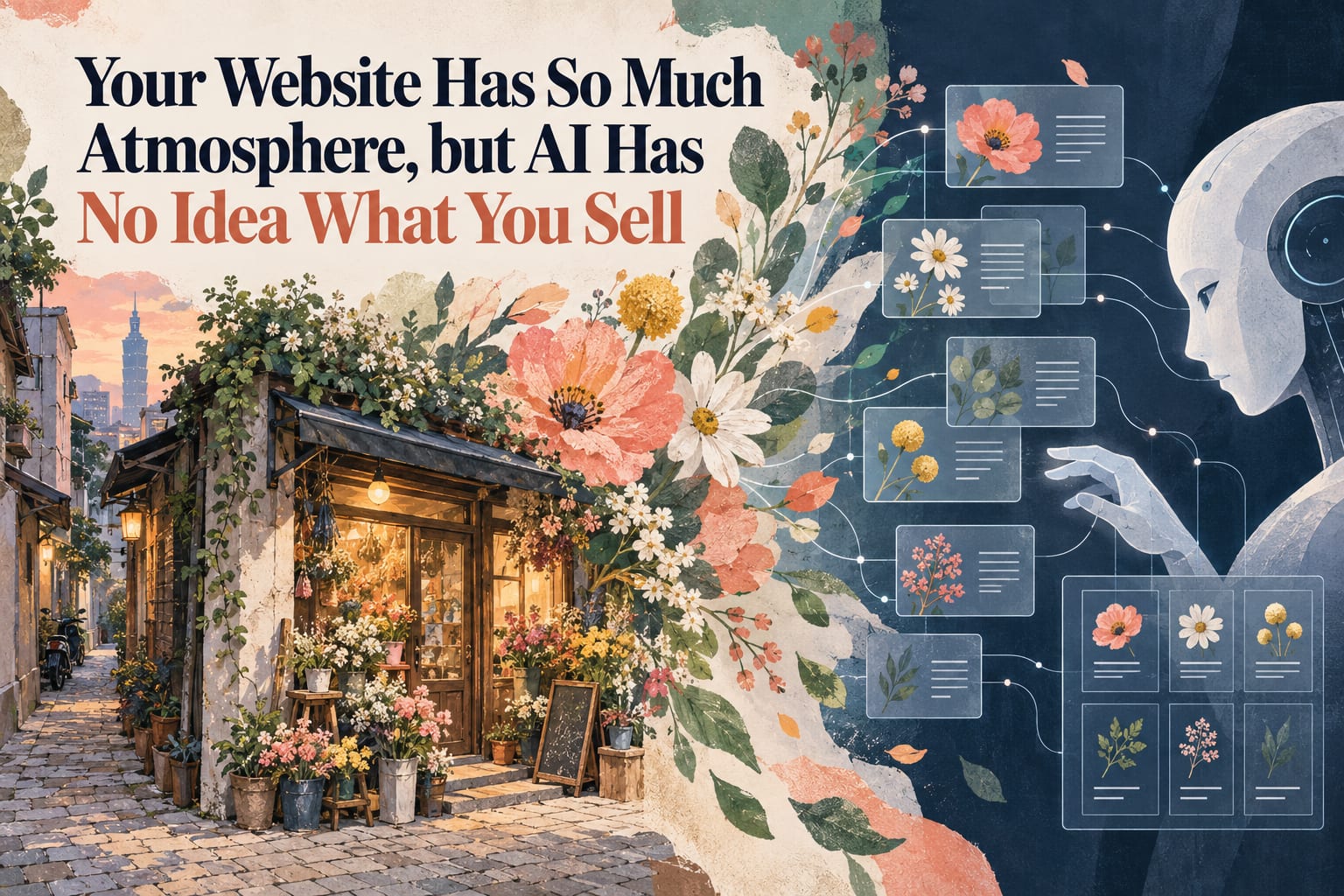
Every time I see a headline ranking AI tools by traffic, I want to turn the camera the other way: everyone is busy guessing who will become the biggest gateway, but beyond that gateway, has anyone recognized the shop tucked away in an alley?
I lean toward a slightly deflating idea: The harder a website works to create an “if you know, you know” atmosphere, the more likely it is to leave AI guessing what you actually do.
For designers, that sentence is practically like asking a barista to add sugar. I get it. White space, metaphor, rhythm—these are the language of a brand. But while people are moved by atmosphere, machines still need to establish: are you a café, a photography studio, or a curated shop selling coffee-scented fragrances?
Aesthetics Cannot Replace an Address
Imagine a floral design studio in Tainan. Its homepage features a photograph beautiful enough to use as wallpaper, with the copy: “Let a little wildness grow into the everyday.”
Beautiful. I would tap the heart.
But someone asks AI: “Are there any floral design studios in Tainan that handle small weddings and take Sunday appointments?” At that point, the poetry says nothing about the scope of services or how to book. If the key information is scattered across images, social posts, and old announcements, the system has to piece together a puzzle—and might end up using last year’s box.
Structured data is like attaching a card with labeled fields to your website. Shared vocabularies such as Schema.org clearly identify information like your name, business type, address, and opening hours; JSON-LD is one common way to write it.
It does not require turning your homepage into a household registration office. The flower photos can stay beautiful, with an additional explanation alongside them that machines can more easily recognize.
The Same Format Can Make Differences Easier to See
“If everyone fills in the same fields, won’t all brands look alike?” That is a reasonable concern. Designers dread being squeezed into a template, as if every shop were forced to wear the same uniform.
But I am more concerned about another kind of flattening: you specialize in restoring old houses, yet your website only says “creating your ideal life”; another designer specializes in newly built homes and uses the very same line. Both people and machines struggle to tell the difference from that.
A shared format can communicate comparable facts; your projects, service details, and writing can then tell the full story of what sets you apart. Structured data does not have to carry the entire brand story. Its job is to make it harder to mix up the people, places, and services in that story.
The implications for digital marketing are practical: before traffic comes in, you need a chance to be correctly identified. Being recommended by AI as a “Taipei wedding photographer” may not warrant fireworks for someone who only takes commercial product photography jobs in Kaohsiung.
Data Cards Can Lie, Too
I do not particularly like describing structured data as a “ticket to AI recommendations.” Search systems and AI services process it differently, and adding markup does not guarantee higher rankings, citations, or recommendations.
More troublingly, the format can be correct while the content is outdated. The website clearly says you are closed on Sundays, but the markup still says you are open; a limited-time service is listed as a regular offering, leaving people who inquire disappointed. The cost of keeping information in order does not disappear once an engineer pastes in a block of code.
So I prefer to see it as part of brand design: how precise your promises should be, who is responsible for updates, and which details should not be filled out just to gain exposure.
In the end, the owner of that floral design studio changed “Sunday appointments available” to “Sundays by appointment; availability must be confirmed in advance.” The homepage still featured that crooked bunch of wildflowers.
A little less crisp, a little more truthful. Her phone lit up. The new message asked: “Are you available for that twelve-person wedding next month?”